
What’s at Stake: Lawmakers Confront Redistricting, Voting Rights and Representation
Omega Network for Action and Delta for Women in Action convene congressional and state leaders for a wide-ranging discussion on redistricting, civic engagement and the future of representation across the South.
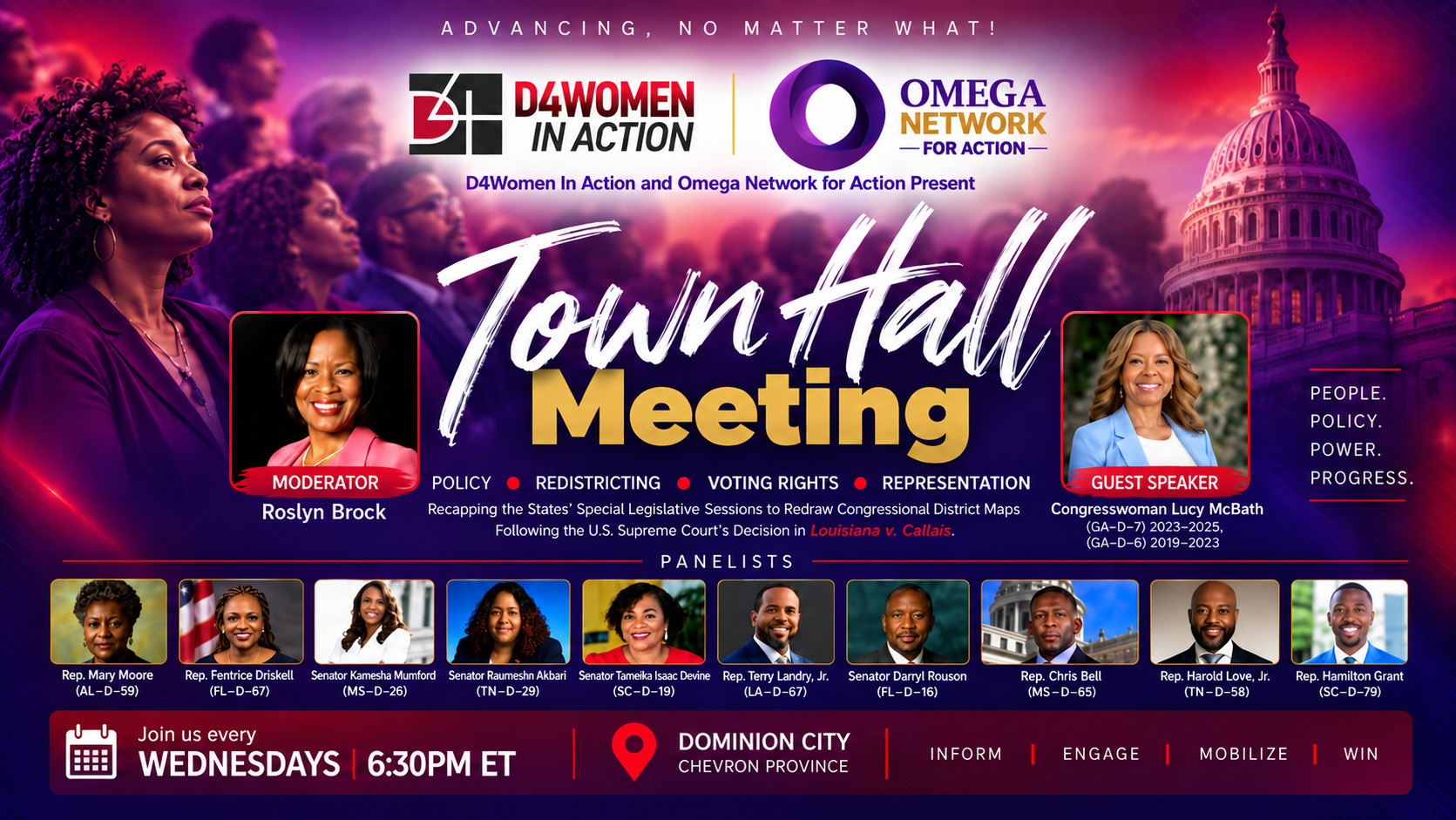
Omega Network for Action and Delta for Women in Action brought together elected officials from across the South for a timely town hall examining redistricting, voting rights, public policy and political representation—and the practical challenges communities face as district lines and election rules continue to evolve.
Moderated by Rosalind Brock, the discussion was designed to provide participants with a clearer understanding of what is at stake in the continuing debate over fair representation and voting rights.
The program opened with remarks from Rhonda Briggins, President of Delta for Women in Action; Beverly Smith; and Dr. David Marion, President of Omega Network for Action. Their messages emphasized collaboration between organizations and the value of bringing elected officials together to share what they are experiencing in state legislatures throughout the South.
“There is no better time to come together than today,” Marion said during his opening remarks, describing the participating legislators as voices coming “directly from the battlefield” of states confronting significant questions about representation.
Congresswoman Lucy McBath: “We Cannot Be Deterred”
Congresswoman Lucy McBath of Georgia opened the substantive discussion by connecting the current debate over voting rights and representation to her own personal and political journey.
McBath reflected on growing up in the Civil Rights Movement and described how her experiences continue to shape her perspective on public service. She also discussed being repeatedly redistricted during her congressional career and the challenges that changing district boundaries have presented.
Despite those challenges, McBath’s message centered on perseverance.
“We will overcome,” she told participants, adding that communities cannot allow obstacles placed before them to deter their continued participation in the democratic process.
McBath also recounted her first congressional campaign in 2018, when she ran in a Georgia district once represented by former Speaker Newt Gingrich. She described being told that a Black woman running on gun safety without previous campaign experience could not win.
She ultimately defeated a Republican incumbent and became the first Democrat to hold the seat in decades.
Her experience provided an opening framework for the evening’s larger discussion: how political boundaries affect representation, how communities respond when those boundaries change and how elected officials maintain connections with voters through that process.
The View From Alabama, Mississippi and Tennessee
The first panel featured Representative Mary Moore of Alabama; Senator Kamesha B. Mumford and Representative Christopher Bell of Mississippi; and Senator Raumesh Akbari and Representative Harold Love Jr. of Tennessee.
The lawmakers examined how redistricting decisions are affecting voter access, political representation and community power in their respective states.
Senator Akbari described changes affecting Memphis, explaining how the city has been divided among multiple congressional districts. She expressed concern that significant changes to districts after election activity has already begun can create confusion and cause voters to lose confidence in the process.
Other participants discussed the importance of helping voters understand their districts, maintaining accurate voter-registration information and creating stronger communication networks between elected officials, community organizations and residents.
A recurring point throughout the first panel was that civic engagement cannot begin only as Election Day approaches.
Panelists discussed maintaining contact with voters throughout the year, building stronger local networks and ensuring residents understand how changes involving district maps, registration and election procedures may affect them.
The panel also emphasized greater coordination among lawmakers across state lines. Representative Moore suggested that Black elected officials from different states can benefit from communicating more consistently, sharing strategies and developing coordinated approaches to issues that extend beyond any single state.
Florida, Louisiana and South Carolina Share Lessons From the Ground
The second panel continued the conversation with Representative Fentrice Driskell and Senator Darryl Rouson of Florida; Representative Terry Landry Jr. of Louisiana; and Senator Tameika Isaac Devine and Representative Hamilton Grant of South Carolina.
Their discussion focused heavily on lessons learned from recent redistricting disputes and the importance of building civic infrastructure before a crisis emerges.
Senator Devine described South Carolina’s experience responding to a proposed redistricting effort while voting activity was already underway. She credited existing grassroots relationships and year-round civic engagement with helping organizations and residents respond quickly.
Her central lesson was straightforward: communities cannot wait until maps are released or litigation begins before organizing.
Representative Landry offered a similar perspective from Louisiana.
“We cannot wait until the maps are drawn,” Landry said, arguing that residents must understand redistricting processes at the congressional, legislative and local levels before final decisions are made.
The conversation also expanded beyond district lines to include election-day preparedness.
Senator Devine and Representative Grant discussed the importance of voters, poll workers and poll watchers understanding election procedures and knowing how to respond to activity at polling locations that may create confusion or concern.
Panelists also addressed younger voters.
Representative Driskell argued that one of the most effective ways to engage younger citizens is to empower young people themselves to carry the message.
“Give them the tools that they need to go and talk to other young people,” she said, noting that peer-to-peer communication can be particularly powerful.
A Broader Call for Collaboration
Across both panels, several themes consistently emerged: preparation, education, collaboration and sustained engagement.
The lawmakers represented different states and described different political environments, but many of their experiences intersected.
They spoke about the importance of understanding how redistricting works before maps are finalized; educating communities about voter registration and election procedures; building grassroots organizations that remain active throughout the year; engaging younger generations; and creating stronger communication among elected officials and civic organizations across state lines.
The evening concluded with each participating lawmaker offering a brief charge.
Representative Hamilton Grant encouraged participants to be “willing to stand in the gap” and continue serving.
Representative Harold Love Jr. offered one of the evening’s most memorable reflections:
“It’s important for us to realize that we are the stewards at this time. … Don’t let the castle fall on your watch.”
Senator Tameika Isaac Devine closed her remarks with another central theme of the night:
“Democracy is not a spectator sport. Real change doesn’t happen because people watch. It happens because people participate.”
Omega Network for Action: Creating Space for the Conversation
In his closing remarks, Dr. David Marion thanked the lawmakers for providing a direct view into what redistricting and representation debates look like inside their respective states.
He said the public needs to hear directly from leaders working on these issues and emphasized that Omega Network for Action and Delta for Women in Action intend to continue supporting dialogue with state legislators.
The town hall demonstrated the value of bringing leaders from multiple states into the same conversation—not simply to describe individual challenges, but to identify lessons that may be shared across communities.
From Georgia to Alabama, Mississippi and Tennessee, and from Florida and Louisiana to South Carolina, the discussion made clear that questions surrounding redistricting and representation do not exist in isolation.
They intersect with voter education, community organization, public policy and the ability of citizens to understand how government decisions affect their representation.
For Omega Network for Action, the conversation provided a platform for lawmakers working closest to those issues to share their experiences directly—and for communities across the South to better understand what is happening beyond their own state lines.

