
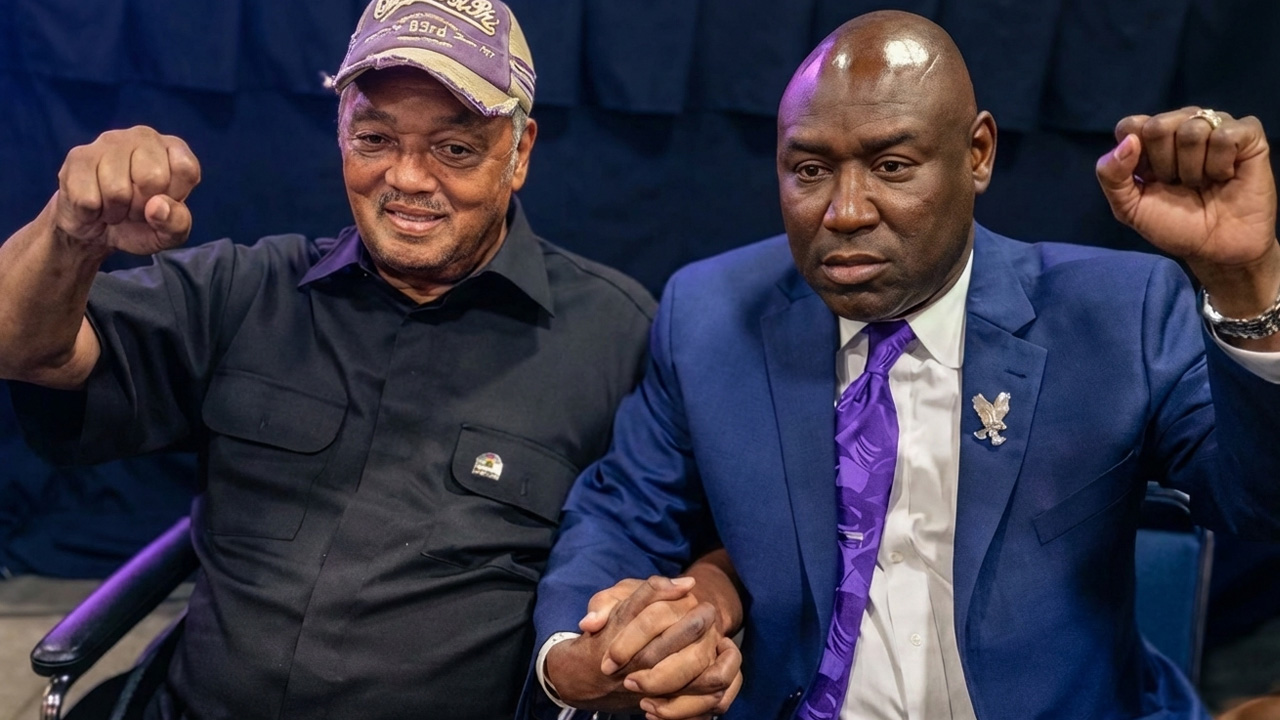
The Rev. Jesse Louis Jackson Sr. died on February 17, 2026, at his home in Chicago. He was 84 years old. His family stated that he died peacefully. In his later years, he faced significant health challenges. In 2017, he announced that he had been diagnosed with Parkinson’s disease. In 2025, the Rainbow PUSH Coalition confirmed that he was being treated for progressive supranuclear palsy, a rare and severe neurodegenerative condition that affects movement and speech.
For more than sixty years, Jackson occupied a visible and influential place in American public life. He was a Baptist minister, civil rights organizer, institution builder, and two-time candidate for the Democratic presidential nomination. His work consistently centered people who lacked political access, economic opportunity, or meaningful representation in the nation’s power structures.
Early life and formation
Jackson was born Jesse Louis Burns on October 8, 1941, in Greenville, South Carolina. He grew up in a segregated society that imposed strict racial boundaries on daily life. He later spoke about early experiences that reflected those realities, including segregated public accommodations and the humiliation attached to racial caste in the South.
He graduated from Sterling High School in 1959 and enrolled at the University of Illinois on a football scholarship. After one year, he transferred to North Carolina Agricultural and Technical State University in Greensboro. There he became active in student leadership, serving as student body president. He married Jacqueline Lavinia Brown in 1962. Together they raised five children over the course of their marriage.
Greensboro in the early 1960s was a center of student protest following the Woolworth’s lunch counter sit-ins. Jackson initially hesitated to participate in demonstrations but later joined and quickly emerged as a leader. In 1963, he led a student march in Greensboro and was arrested. The experience marked a deeper commitment to organized activism.
After earning his degree in 1964, he enrolled at Chicago Theological Seminary. The violence against voting rights demonstrators in Selma, Alabama, in 1965 prompted him to take a more direct role in the movement. He traveled south and began working more closely with leaders of the Southern Christian Leadership Conference.
Work with Dr. Martin Luther King Jr.
Jackson joined the staff of the Southern Christian Leadership Conference and became, at age 24, its youngest member. He was assigned to lead Operation Breadbasket in Chicago. The program sought to pressure companies to hire Black employees and to contract with Black businesses. The strategy relied on negotiations, boycotts, and organized community pressure to influence corporate practices.
Through Operation Breadbasket, Jackson developed a reputation for combining religious language with economic demands. The effort linked moral arguments about justice with practical outcomes such as employment and contracting access.
Jackson was in Memphis in April 1968 when the Rev. Dr. Martin Luther King Jr. was assassinated. In the aftermath, Jackson gave public accounts of his presence during King’s final moments. Some of those accounts were later questioned by other aides who were present. The dispute became part of the public narrative surrounding his career and contributed to ongoing criticism from some quarters.
Founding Operation PUSH and Rainbow PUSH
In 1971, after breaking with SCLC leadership, Jackson founded Operation PUSH, which stood for People United to Save Humanity. The organization was based on Chicago’s South Side and focused on economic inclusion, voter registration, education, and corporate accountability. In 1996, the organization became the Rainbow PUSH Coalition following a merger.
Rainbow PUSH convened weekly public forums that blended civic education, political analysis, and community mobilization. Over time, the organization engaged corporations on hiring practices, board diversity, minority contracting, and access to capital. It also registered voters and advocated for public policies affecting underserved communities.
Jackson’s approach frequently combined public protest with direct negotiation. Companies that were publicly criticized were often later engaged in discussions that resulted in formal commitments related to employment and procurement.
Presidential campaigns and national influence
Jackson sought the Democratic presidential nomination in 1984 and again in 1988. His 1984 campaign established the National Rainbow Coalition as a political vehicle. In both campaigns, he won several primaries and caucuses and received millions of votes. Although he did not secure the nomination, his campaigns demonstrated that a Black candidate could compete seriously in a national presidential contest.
His speeches at the Democratic National Conventions in 1984 and 1988 drew national attention. He emphasized coalition politics and appealed to voters who felt excluded from economic and political decision-making. His campaigns were also linked to expanded voter registration efforts, particularly among Black Americans.
Jackson did not hold major elected office. However, in 1990 he was elected as one of two unpaid “statehood senators” created by the District of Columbia to advocate for statehood. The role did not carry legislative authority but provided a platform for advocacy.
International engagement and public advocacy
Beyond domestic politics, Jackson was involved in international diplomatic efforts. In 1984, he helped secure the release of U.S. Navy Lt. Robert Goodman, who had been captured in Lebanon. In 1990, he negotiated the release of foreign nationals held in Iraq following its invasion of Kuwait. In 1999, he assisted in securing the release of three American soldiers held in Yugoslavia.
Jackson also met with international leaders, including Nelson Mandela, and spoke publicly on global human rights issues. His work connected domestic civil rights advocacy with broader international concerns about freedom and representation.
Later years
Jackson continued to appear at rallies and public events well into his seventies and eighties. He participated in demonstrations related to voting rights and racial justice. During the COVID-19 pandemic, he publicly received a vaccination and encouraged others to do the same.
In 2000, President Bill Clinton awarded him the Presidential Medal of Freedom. In his final years, despite declining health, he remained symbolically present at civic gatherings and public commemorations.
A legacy of organized advocacy
Jesse Jackson described himself as a moral leader whose mission was to influence the nation’s conscience. Across six decades, he built organizations, mobilized voters, negotiated with corporations, and entered national political contests. He sought to expand access to jobs, education, voting rights, and public recognition for communities that had long faced barriers.
He is survived by his wife, Jacqueline, his children Santita, Jonathan, Yusef, Jacqueline, and Ashley, and his grandchildren. His career left behind institutions, political precedents, and a record of sustained public engagement that shaped American civic life from the civil rights era through the early twenty-first century.

