
Step by Step: What the Monks’ Walk for Peace Teaches Us About Community, Courage, and Civic Healing
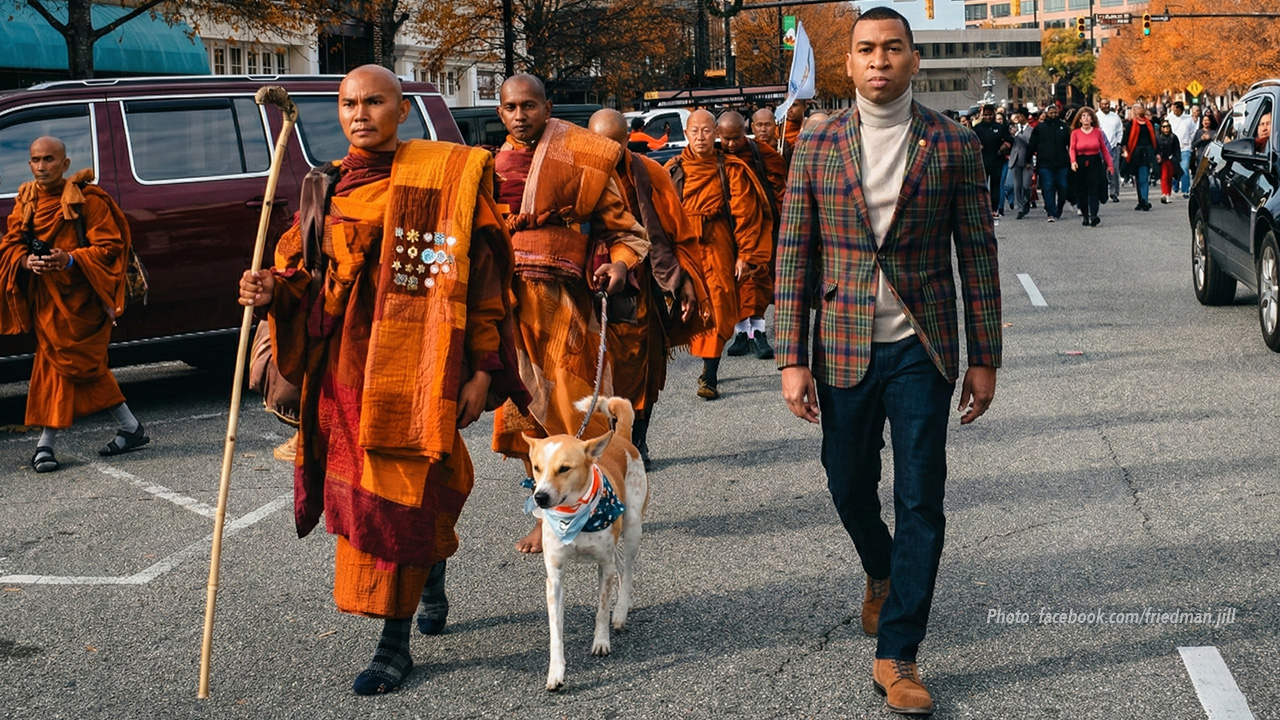
On highways, city streets, and quiet back roads across the American South, a small group of Buddhist monks has been carrying out an act of deliberate simplicity—walking. The Walk for Peace, a 2,300-mile journey from Fort Worth, Texas, to Washington, D.C., is not framed as a protest or a campaign. Instead, it is a sustained act of presence, inviting communities to pause, reflect, and consider what peace looks like in practice rather than theory.
As the monks moved through Georgia and neighboring states, their arrival transformed ordinary spaces into moments of shared humanity. Sidewalks became gathering places. Silence became a language. And in many towns, residents responded not as spectators, but as participants in something larger than themselves.
A Quiet Impact That Resonates Loudly
The physical endurance required for a four-month walk is undeniable. Yet the deeper impact of the journey lies in its intentionality. The monks selected cities shaped by complex histories—places marked by struggle, division, and resilience. Their message does not attempt to erase that history, but to acknowledge it while offering an alternative way forward grounded in compassion and responsibility.
Even after a serious accident outside Houston injured two monks when an escort vehicle was struck, the walk continued. The decision to move forward—without anger, without retreat—reinforced the core principle behind the journey: peace is not the absence of hardship, but the manner in which hardship is met.
Communities Lean In
The response along the route has been striking. Crowds have gathered in small towns and major metro areas alike. Local leaders have issued proclamations, law enforcement agencies have provided escorts, and residents have lined streets with handwritten signs, flowers, and quiet gratitude. Many shared deeply personal stories—of loss, healing, and hope—suggesting that the walk arrived at a moment when people were ready to listen.
What stands out most is the diversity of those drawn to the monks’ presence. People of different faiths, political views, and cultural backgrounds have joined sections of the walk or attended peace gatherings. Even moments of disagreement have been met not with confrontation, but with calm acknowledgment and goodwill.
Reflections for Civic and Community Work
For organizations committed to strengthening communities and encouraging meaningful civic engagement, the walk offers lessons worth considering.
First, visibility matters. By physically entering communities rather than speaking about them from afar, the monks modeled a form of engagement rooted in proximity and trust. Second, their journey underscores that transformation is both internal and collective. Structural change requires policy and advocacy, but it is sustained by people who feel connected to one another and invested in shared outcomes.
This balance—between inner work and public action—is familiar terrain for groups focused on long-term community uplift. The monks’ walk quietly affirms that unity is built through consistent, values-driven action, not singular moments or slogans.
Peace as a Daily Practice
As the journey continues toward Washington, D.C., the monks remain clear about their purpose: they are not walking to divide, persuade, or convert, but to remind. Their steps suggest that peace is not something we wait for—it is something we practice, repeatedly, in how we show up for one another.
For those engaged in civic leadership, advocacy, and community development, that reminder feels timely. Progress often begins not with sweeping declarations, but with sustained commitment—step by step, block by block, person by person.
Those interested in following the monks’ progress or reflecting alongside them can find regular updates on their Facebook page:
https://www.facebook.com/walkforpeaceusa
Learn about the work being done through Omega Network for Action offers another example of how values translate into action:
https://omeganetworkforaction.org

